
Navigating transition inequalities across the policy cycle
16 October 2026

Europe is going through a green and digital transformation, from renovating buildings and phasing out coal to digitalising public services and training people for new digital-based jobs. Everyone is meant to benefit, but not everyone seems to start from the same place. Some regions have strong institutions, well-funded companies and skilled workers, while others have far fewer resources or capacities. The costs and benefits of transitions can differ between people, sectors and places, depending on existing inequalities, institutional capacities and the way policies are designed, implemented and evaluated.
We asked a question that is often overlooked: how do existing inequalities shape the policies that support the transitions, and how do those policies in turn shape, reinforce or mitigate inequalities?
We explored the answer to this question in the ST4TE ‘Report on policy perspectives of inequalities in transition processes.’ In the report, we examined transition policies through the policy cycle lens: how a problem gets on the agenda, how a policy is designed, how it is put into practice and how it is monitored and evaluated. The analysis considered policymaking as a dynamic process in which priorities, actors, institutions and policy instruments can change over time. It also recognised that governments are not the only actors involved: businesses, researchers, civil society and other stakeholders can influence how policies are designed and implemented.
The analysis drew on six case studies in EU countries, covering green, digital and twin transitions, while comparing the so-called front-runners to the countries falling behind on these transitions, namely:
Netherlands — Digital transition: structural labour-market inequalities, with a focus on skills, migration, youth and access to employment opportunities.
Portugal — Digital transition: digital skills and the capacity of the manufacturing sector, particularly SMEs, to adapt to Industry 4.0.
Austria — Green transition: distributional effects of carbon pricing, focusing on the design and implementation of the CO₂ price and the Klimabonus compensation mechanism.
Lithuania — Green transition: energy efficiency and energy poverty, focusing on the renovation of multi-apartment residential buildings.
Ireland — Twin transition: interactions between digitalisation, green transition and inequalities, through data centres linked to climate adaptation.
Greece — Twin transition: the role of policy and institutional conditions in shaping participation in twin transition of coal-dependent region, including territorial and socio-economic inequalities.
For each case study we reviewed policy documents, existing data and interviewed key stakeholders linked to policy design, implementation and evaluation. The purpose was not to determine which country has the “best” transition policy, but rather to understand where and how inequalities enter the policy process, how they interact with other factors, and where policy action can make a difference.
Main findings
Policies are rarely unfair on purpose. But when they assume everyone starts with similar capacities, they tend to favour those who are already better placed and equipped to benefit from them. Across the cases studies, several drivers, i.e. forces that contribute to the emergence, reinforcement, or mitigation of inequalities at different stages of policymaking, appeared repeatedly. EU policy and funding, governance and administrative capacity, and skills and human capital were particularly prominent. Their relative importance also differed between transition contexts: governance issues were especially visible in the green transition, skills in the digital transition, and EU policy and funding in the twin transition. Territorial disparities also stood out in the digital transition cases, while financial structures were important for the green transition.
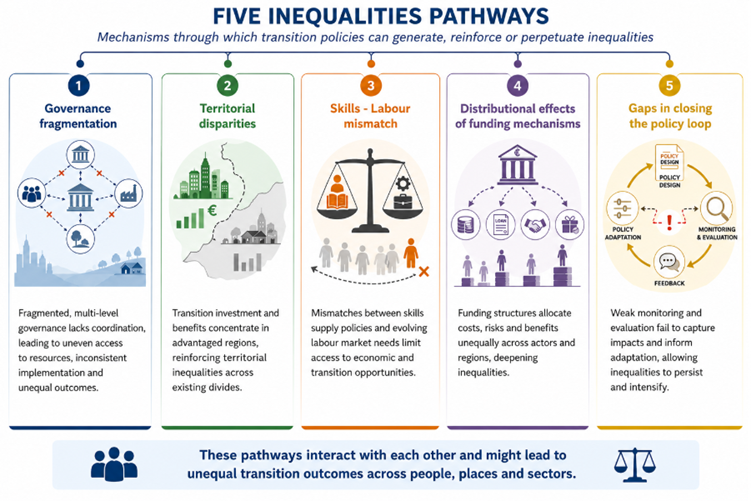
The analysis ultimately led to five recurring patterns, we called “inequality pathways”:
Fragmented governance: fragmented, multi-level governance structures lack coordination and prevent coherent policy design and implementation across actors, sectors and territories. This coordination failure leads to uneven access to resources, inconsistent policy implementation and unequal policy outcomes often exacerbating existing inequalities.
Territorial gaps: policies tend to concentrate transition-led investment, innovation, and benefits in already advantaged and more capable regions. This contributes to reinforcing territorial inequalities across existing divides (urban/rural, income and skills, employment, etc.).
Skill mismatches: structural mechanism of inequality in which discrepancies between policy-directed skill formation systems and the evolving demands of the labour market produce uneven access to economic and transition opportunities.
Uneven effect of funding: it captures how funding structures—such as co-financing requirements, credit-based schemes, loans, and performance-contingent grants—can differentially allocate costs, risks, and benefits across actors and regions with varying levels of financial capacity thus deepening and driving inequalities.
Weak feedback loops: pattern of weak monitoring and evaluation systems that fail to capture policy outcomes and impacts, preventing appropriate feedback mechanisms and policy adaptation to address inequalities. In this case, it allows initial design shortcomings or inequitable outcomes to persist and potentially intensify over time.
Policy implications
Three conditions emerged as signs of high-risk: assuming all territories and actors start with equal capacity; relying too heavily on market mechanisms to distribute resources; and lacking ways to monitor and correct deviations in expected policy effects.
These outcomes are however not inevitable. The study identifies some ways forward:
Make fairness part of the design: equity should shape which tools are chosen and how funds are allocated, not be added afterwards as compensation.
Support those with less capacity: local authorities, small businesses and community organisations need practical help, such as simpler applications, technical assistance or supporting financial instruments.
Long-term system perspective: transitions last longer than political and budget cycles. Policies need to acknowledge these while working in coordination with broader policy domains such as industry, employment, regional development, cohesion, etc.
The central message of the analysis is straightforward: a transition policy is not only about what it aims to achieve, but also about how it is designed, who can participate, who can access resources it provides, where it is implemented and how its results feed back into future decisions. A fair and equitable transition depends on policies that recognise different starting points and navigate policy development through corrective and adaptive measures.