
Europe’s Uneven Twin Transition: What the Geography of Green and Digital Jobs Reveals.
28 November 2025

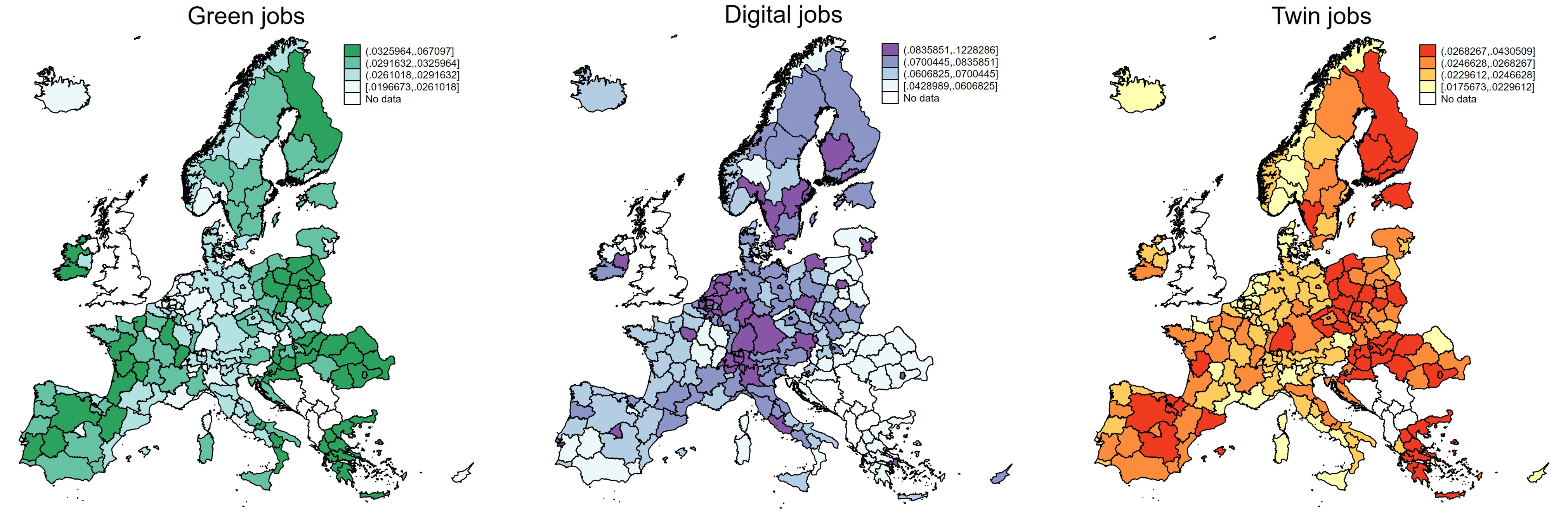
Europe’s twin transition is often framed as a single transformation—a simultaneous shift towards sustainability and digitalisation. Yet new evidence suggests that something more fragmented is unfolding beneath the surface. Mapping green, digital, and so-called “twin” occupations across Europe reveals not one transition, but several overlapping ones, each following its own spatial logic and drawing on different segments of the workforce.
Green jobs, for instance, are widely dispersed. They appear both in cutting-edge technical and managerial roles and in traditional, labour-intensive activities such as agriculture, waste management, and resource conservation. In Eastern and Southern Europe—Romania, Greece, Spain—green employment remains anchored in lower-skilled categories. In Northern and Western Europe, by contrast, green roles gravitate toward professionals and technicians, reflecting more innovation-driven pathways.
Digitalisation tells a different story. Digital jobs are overwhelmingly concentrated in metropolitan regions—Stockholm, Helsinki, Île-de-France, the Madrid region—where high-skilled ICT professionals dominate. Rural and peripheral regions in Southern and Eastern Europe participate mainly through mid- or low-skilled roles, indicating that Europe’s digital transition risks deepening existing divides unless new entry points are created.
If green jobs are wide and diverse, and digital jobs narrow and concentrated, then twin jobs—those combining green and digital skills—sit somewhere in between. They are still rare, and where they do surface, they appear more “green-anchored” than “digital-anchored.” Many emerge in operational roles—maintenance, monitoring, environmental services—rather than in high-skilled strategic positions. Advanced regions, unsurprisingly, are developing high-skill hybrid profiles, but Southern and Eastern Europe show early signs of catch-up, particularly where green capabilities are strong. This suggests that the twin transition, at least for now, is unfolding primarily through the greening of existing occupations rather than through the digital reinvention of the workforce.
A crucial insight from the report concerns the role of “enabling occupations”—jobs not explicitly green or digital but closely connected to both through shared skills. Regions rich in enabling roles perform better across all transition indicators. These jobs—administrators, coordinators, technicians—act as the connective tissue of transformation. Strengthening them may be Europe’s most effective lever for accelerating the transitions.
At the regional scale, a dual Europe emerges: high-skilled, innovation-driven transitions in the North and Centre; labour-intensive and operational transitions in the South and East. Yet growth patterns suggest the map is not fixed. Several peripheral regions—especially in Greece, Spain, Poland, and Romania—have shown rapid increases in high-skilled green and twin occupations between 2016 and 2022, hinting at early convergence dynamics. These are fragile gains but important signals that the geography of the twin transition is not predetermined.
Ultimately, the report reveals that Europe is not experiencing one twin transition but multiple transitions layered on top of one another—green-led, digital-led, hybrid, or path-dependent. Recognising this diversity is the first step toward supporting a just and territorially cohesive transformation. The second is designing place-sensitive policies that build on existing strengths—whether they lie in high-end digital clusters or in the green capabilities embedded in long-standing regional economies. The future of the twin transition will depend on Europe’s ability to embrace these different pathways, not flatten them.
Article prepared by Ugo Rizzo, University of Ferrara